«Rain, Steam and Speed» (Case Study)
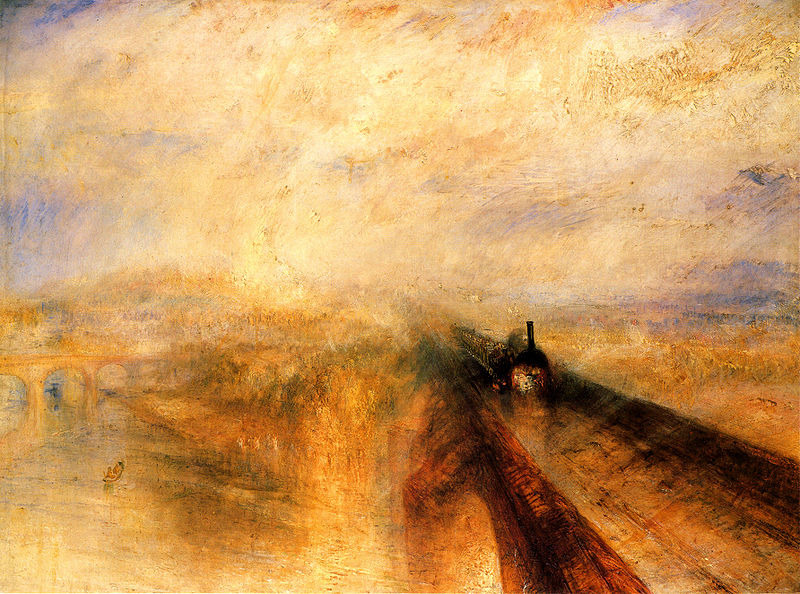
«Rain, Steam and Speed: The great western railway»
William Turner
He lived in the late seventeenth and mid-eighteenth century and it’s one of the most prestigious and important British landscape painters, being also a great master of watercolour. His style was characterised by different atmospheric washes of paint which created luminosity, brightness and glare, and it was focused on the movement of the Romanticism painting that supported the revolt against the aristocratic social rules.
In this context we’ve got the Industrial Revolution, which was promoted by James Watt by having created the steam engine, the machine that would be applied to the popular locomotive. After that, the society started changing its mentality to the point of having two different stages of the revolution itself.
The first stage highlighted by the huge number of new inventions like the bulb and the subsequent spread through the rest of Europe. This was the stage that influenced William in his paintings and later we’ll see why.
The second stage of the Industrial Revolution (in the late nineteenth century) had the fully incorporation of capitalism, technological, scientific and economic innovations and the emergence of new factories in areas like the textile industry.
Knowing the context in which we are, we can go now to:
“Rain, Stream and Speed –The Great Western Railway”
This painting is called “Rain…” and its dimensions are 91 times (121) one hundred and twenty one cm and it’s exposed in the National Gallery in London.
The part of “The Great Western Railway” stands for one private British railway company that supported the painter, so the actual name would be just “Rain, stream and speed”.
In technical analysis we’ve got a technique in oil on canvas and in the formal one, we’ve got a composition where we can see a dark train with a steam locomotive, crossing a viaduct, at full speed towards us, the rain and its own steam.
At first glance you can see large patches of paint, but if you look closely, a railroad, a small boat on the river, the bridge piers, smoke, cars and even passengers can be seen.
We see a low horizon line slightly converging towards the 2 lines of the railway. We see the locomotive coming towards the viewer, tending to the right of the composition. On the opposite side of the picture we can see through the mists of the arches of a landscape bridge. Bright colours predominate throughout the painting, from the brightness of the River Thames to the smoke of the train which is even white, shining, glowing instead of black and dark.
The relationship between this piece with the topic is the beginning of technology incorporation to society by setting up the railroad from the UK to the rest of Europe.
Why this topic?
Because we are in the XXI century, we are part of Western civilization, because we have gathered and develop the consequences of successive industrial revolutions since the late eighteenth century.
Comentarios recientes